
Latch hardware systems and the security and access environment revolve around latches, the door's backbone security element. Over-shadowed many times by their more glamorous counterparts - the locks, latches keep the door and gates in our homes, businesses, or industrial settings secure. This will be an in-depth review of latch mechanisms, their applications and how you can settle on the option right for your specific needs.
What Is a Latch?
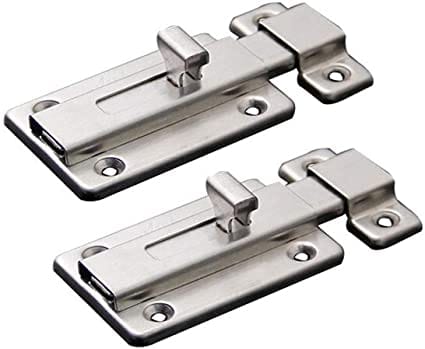
A latch is a mechanical fastening device that joins two surfaces or objects together and, when desired, may be opened up without damage. These do not generally involve a key for normal operation (though many can readily accept a padlock or closed by a security door electric strike) whereas an ordinary lock is a bolt that is thrown forward or backward by a key. In other words, the primary function of a latch is to maintain a door, gate, or panel closed while making it easy, and only when desired, provision for release.
Common Latch Types and Their Applications
Fornd provides a comprehensive portfolio of high-performance industrial latches and hardware, focusing on secure closure and long-lasting durability. Their product range encompasses a variety of latch types, including compression, draw, cam, push-to-open, and concealed latches, addressing diverse industrial requirements. Fornd's emphasis on robust design and reliable performance makes their hardware ideal for demanding applications across machinery, electrical enclosures, transportation, and other sectors.
Slide-to-open Latches
Slide-to-open latches are identified by the simple sliding movement they make in engaging and disengaging. These latches, typically just having a bolt or tongue that moves in a sliding linear motion inside a housing, engaging or disengaging when an actuator in one housing is slid, offer a simple design that centers much on ease of use and quick access to whatever one wants. They are meant for applications where maximum speed and efficiency are to be realized.
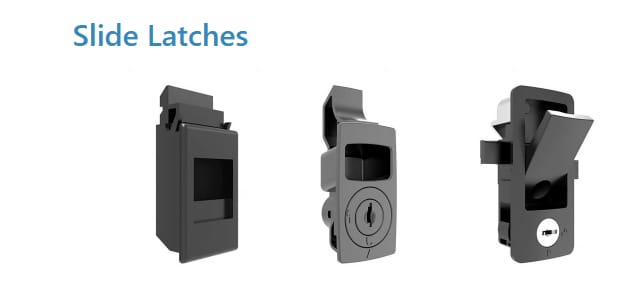
Slide-to-open latches find many applications in the industrial setting. One common application is the machinery enclosure because sliding panels or doors need frequent access for maintenance or adjustment. A quick linear action made these latches easy to operate without involved maneuvers. They are also frequently used in drawers and inside compartments of industrial workstations or storage units where tools or components need proper organization and quick availability. They are also used in electrical cabinets where sliding access panels allow quick inspection or component replacement to make downtime minimal.
Draw Latches
A draw latch, tension latch, or over-center latch is a mechanical fastener that pulls two surfaces together very tightly and holds them under great tension. From one surface to another, it normally latches the lever or handle to a hook or a bail engaging a catch or loop. And when the lever is closed, drawing the two surfaces together, it creates an over-center locking action that creates tension and prevents them from pulling apart. This kind of latch provides a very strong closure, keeping out vibration, so it is very good in applications that need that sort of thing.
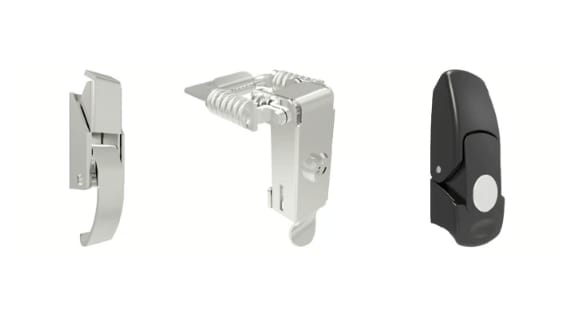
Common applications include access panels, hatches, and doors of machinery enclosures to ensure that the panels remain firmly closed during the equipment's operation. An excellent resistance to both vibrations and impacts has made them very suited to transportation applications—securing cargo containers, truck bodies, and trailer doors. More commonplace instances of use of the draw latch might be found in environmental control systems as used in HVAC units and filtration systems, where they have to keep an airtight seal to prevent leakage. Besides, they find their operation in different types of industrial storage solutions, used in toolboxes, cabinets, or equipment cases when a closure is needed for something heavy or something that you would frequently access.
Compression Latches
Compression latches are mechanical fasteners meant to provide a secure, sealed closure by applying compressive force between two surfaces. They work by two surfaces being clamped together and effectively latching, as compared to simple cam latches, which are only rotational locking. Here the action of compression is clamping gaskets between the panels with a cam or lever system that exerts a clamping force when actuated to effectively seal the gap between the panels. Simple cam latches do not compress the seals and gaskets between the panels; hence, they do not clamp the door securely.
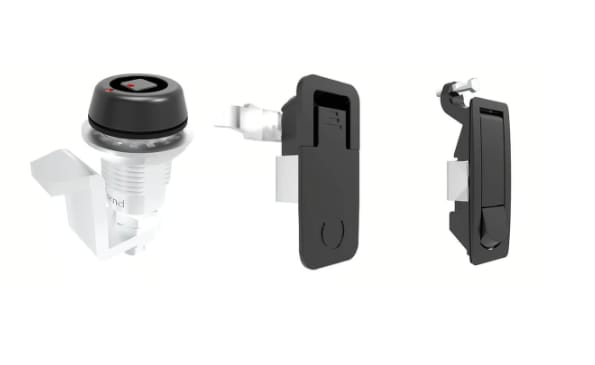
Compression latches are usually installed in electrical housings and control panels since they prevent dust, moisture, and electromagnetic interference from the enclosed sensitive components. It is essential for use in HVAC systems where a complete seal is necessary for proper operation of that equipment. For use in transportation and securing access covers and doors to cars and equipment, respectively, dynamic conditions require the covers and doors to be sealed against rattling and safe closure. It is also used in food processing and pharmaceutical equipment because hygienic seals are necessary to prevent contamination of any product.
Pull Latches
The pull latch is meant to provide strong and safe fastening by using a handle or a lever that pulls and, in the process, disengages or engages a locking mechanism. The basic and real function of the latch is based on a strong, very mechanical linkage, which gives translating taking force into a positive locking action. Such specific design normally becomes the appropriate application that requires high holding strength coupled with durability in very harsh workings.
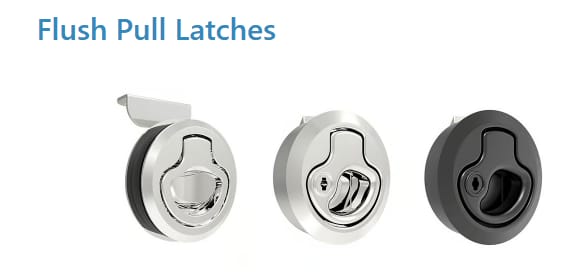
In industrial applications, pull latches are necessary for appropriately binding heavy access doors and panels where the operator needs a reliable closure capability. For applications subjected to vibration, impact, or dramatic temperature variations, latch ability to withstand tremendous forces makes them very valuable. Use is widespread on large industrial doors that must be well-sealed securely. Inasmuch as they are tenable in other applications of transportation for keeping doors and panels suitably fastened firmly during conveyance, their sturdiness and dependability also suit them.
Pull-to-Open Latches
Pull-to-open latches are applied to latches that require an action of pulling to be opened. The usual type of operation for this kind of latches is whereby other common latches are push-to-open or simple hook-and-eye latches. The difference is that pull-to-open latches are provided with a more specific means of releasing, sometimes designed primarily for increased security or controlled access. The means can be a lever to be pulled for the latch to disengage or a handle that requires a certain amount of force to be activated.
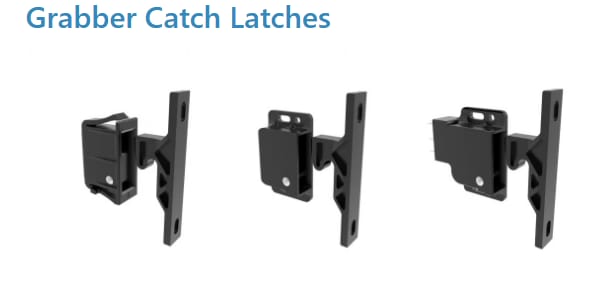
Pull-to-open latches are mainly used in situations in which a controlled release is needed; more specifically, they are standard on machinery and equipment access panels (wherein accidental opening leads to a situation harmful to safety or the machines involved). It would let the person make an explicit request to open by pulling which proved who had access. Sometimes, safety doors have to be closed securely to protect people from hazards or take care of dangerous materials; since the door is only a bearer for all this, the latch and door are organized with some safety involved. The latch would make sure the door stayed locked until it was meant to be opened, adding another level of safety as well as security.
Concealed/Remote Latches:
Concealed/remote latches are designed for applications needing both aesthetics and high levels of security. Its feature is that you do not see any part of the latching system when the door or panel is closed; it is just a smooth and uninterrupted surface. Actuation is mostly by internal or remote means, which reduces the visibility of the hardware. This design gives the latch a clean and elegant look while at the same time providing more security against unauthorized access.
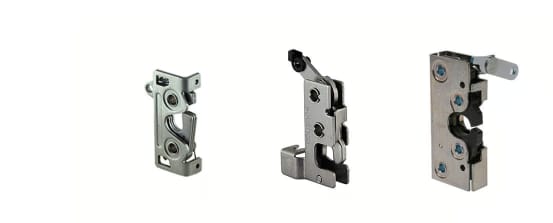
Concealed or remote latches find their niche mostly in industrial applications where aesthetics are to reflect an aura of non-compromise as well as good security. High-end machinery, electronic equipment, and means of transport are examples of applications that will want to maintain clean, modern appearances while at the same time ensuring that all their respective components are not unduly interfered with. In environments where aesthetics, or even security, are important, being hidden, it is thus relatively harder for someone to tamper with such systems, and gives a very flush outside application due to its very smooth exterior. Above and beyond, it is used in specific applications where surface continuity is preferred and actualized to avoid hardware fasteners that may protrude, hence interfering with aesthetic consideration or functionality.
Knob Latches
The knob latches work by a simple rotary operation through a knob that you can turn to either engage or disengage the latching mechanism. Such a design makes this latch very easy to secure doors and panels with, hence finding its application in most types of industries. When there is need for manual operation, the rotary action is fast and secure in locking.
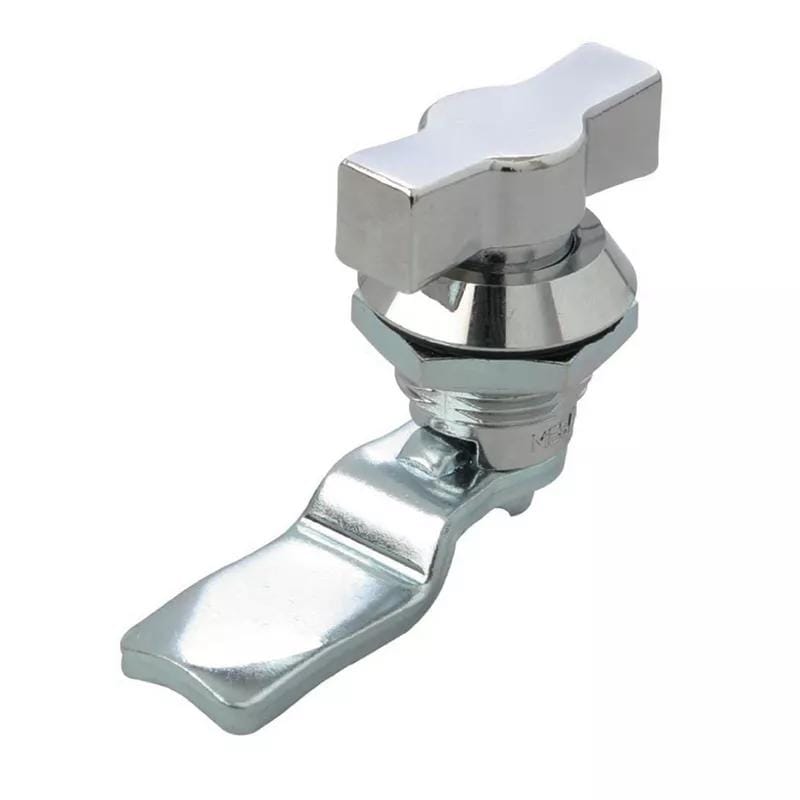
Knob latches are common in industrial use on access doors and panels where ease of access is important because of easy use. They find their way into tool storage cabinets, toolboxes, and equipment enclosures, providing secure closing while at the same time providing quick access to stored items. Their simple turning mechanism makes knob latches ideal for easy and quick access since a simple turning mechanism is ideal for frequent use, for example, in the opening and closing of access panels to storage units. In addition, application fields for knob latches abound in all kinds of industrial furniture, often securing drawers, doors, and other access points.
Selecting the Right Latch: Key Considerations
Security Requirements
The primary consideration when selecting a latch should be the required security level. External doors generally benefit from deadlatches or mortise mechanisms, while interior doors may only need tubular latches.
Door Type and Thickness
Different latches are designed for specific door materials and thicknesses. Ensure your chosen latch is compatible with your door construction—whether it's solid wood, hollow core, metal, or composite.
Frequency of Use
High-traffic areas require durable latches with quality components. Commercial settings typically benefit from Grade 1 (highest durability) hardware, while residential applications may function well with Grade 2 or 3 hardware.
Fire Safety Compliance
In many jurisdictions, fire doors require specific latch types that maintain closure during fire conditions. Always verify that your latch meets local fire safety regulations for its intended application.
Accessibility Requirements
Consider whether the latch needs to comply with accessibility standards such as ADA in the United States. Lever handles, for instance, are typically more accessible than doorknobs.
Installation Considerations
The correct installation of latches is crucial for both functionality and security. Key installation factors include:
· Accurate measurements: Particularly backset distances and door thickness
· Proper alignment: Between the latch and strike plate
· Quality hardware: Using provided screws or upgrading to longer security screws
· Professional installation: For high-security applications or complex systems
Maintenance and Troubleshooting
Even the most durable latches may encounter issues over time, necessitating occasional maintenance. Here are some common problems and their solutions:
Misalignment: This usually occurs when the latch bolt fails to contact properly with the strike plate, hence the door dragging or not remaining locked. For example, if you should slam the door too hard, and it should be noted that the latch bolt scrapes the strike plate; you should loosen the screws and reposition the plate until the latch enters smoothly into it.
Sticking mechanisms: When surfaces reach a point where they stick, they should be cleaned and lubricated with a dry lubricant or silicone-based lubricant. A thin film of oil-based graphite applied to the lock mechanism will go a long way to ensure the lock continues to work well. In wood installations, the oil-based graphite should be kept to a minimum, as it could damage the wood.
Loose components: Another typical cause of screws and fasteners coming loose is vibration and the natural movement of materials over time. For example, you notice it as you close the door and the latch handle feels wobbly or the strike plate moves back and forth. You can then tighten all the visible screws and fasteners with a screwdriver.
Spring fatigue: Over time, the spring within the latch mechanism can lose its tension, resulting in a weak or ineffective latch bolt. If the latch bolt no longer extends fully or fails to retract when actuated, the latch will not be secure properly, leading to potential security breaches or unintended openings.
About Fornd
Fornd, a seasoned manufacturer of industrial cabinet locks and hardware, offers a broad spectrum of solutions for industrial applications. Their product line includes high-quality electronic locks, hinges, handles, and latches, showcasing their deep industry expertise. Discover their comprehensive offerings on the Fornd website: https://fornd.com.